

A Target Without a Roadmap
At COP31 in Antalya, from 9 to 20 November 2026, the Presidency will promote an initiative with a deceptively simple name: “35 by 35”, electricity supplying 35 percent of global final energy consumption by 2035. The logic, set out by the Energy Transitions Commission and taken up in an Asia-Pacific webinar on 22 October 2026, is that clean electricity is the fastest route to decarbonisation across power, transport, buildings and industry, and that electrification also cuts energy costs and exposure to volatile fossil fuel markets, a point sharpened in 2026 by disruption to global oil supplies after the closure of the Strait of Hormuz.
Indonesia is, in principle, well placed to join that argument. It has abundant solar, hydro, geothermal and wind resources, a state utility with a ten-year plan that claims three quarters of new capacity will be renewable, and a 100 gigawatt-peak solar ambition. It also has a problem that the Institute for Essential Services Reform (IESR) stated plainly on 20 October 2026: Indonesia has no clear electrification target of its own to match the global initiative, and no roadmap that maps renewable potential, grid capacity and storage onto a higher electricity share. Without that roadmap, “35 by 35” risks becoming another target Indonesia endorses abroad while its domestic electricity plan points in a different direction.
This article examines that gap. It compares what PLN’s 2025 to 2034 Electricity Supply Business Plan (RUPTL) actually adds, what independent analysis says it leaves out, and what a credible Indonesian electrification package at COP31 would need to contain.
What the RUPTL Promises
PLN’s RUPTL 2025 to 2034, approved in May 2025 and published in June 2025 under the theme “Beyond the Greenest”, is the largest electricity programme in Southeast Asia. It plans 69.5 gigawatts of additional generation capacity, with about 76 percent from new and renewable energy integrated with advanced storage, according to PLN’s summary. The detailed breakdown reported from the plan includes 17.1 gigawatts of solar PV, 11.7 gigawatts of hydro, 7.2 gigawatts of wind, 4.3 gigawatts of battery energy storage, 10.3 gigawatts of gas, and an initial 0.5 gigawatts of nuclear, in two 250 megawatt plants planned for Sumatra and Kalimantan. Total investment is projected at IDR 2,967.4 trillion, about USD 185.5 to 188 billion, with about 73 percent expected from independent power producers.
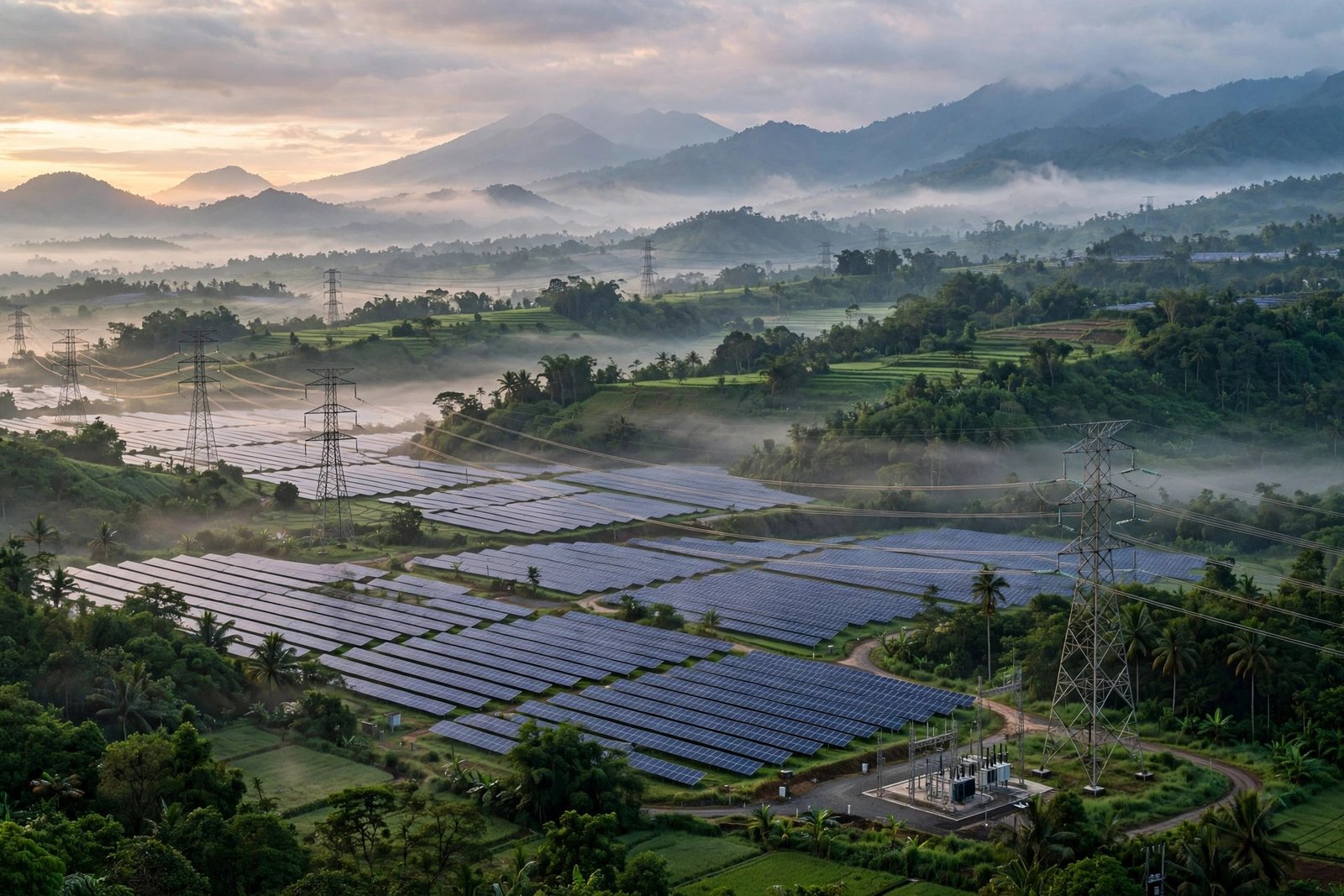
The transmission story is as important as the generation story. PLN is preparing a Green Enabling Supergrid of about 48,000 kilometres of transmission circuits to connect renewable resources, often far from demand centres, to load centres, and is opening transmission and substation development to private participation. As of March 2026, PLN reported 547 priority projects, with 353 in procurement, 156 under construction and the remainder in commissioning, a net installed capacity of 71 gigawatts, and a reserve margin of about 39 percent. In the first half of 2026, PLN prepared 21 solar projects, including solar integrated with battery storage, for execution, as part of a programme to replace diesel generation at 741 locations with 2,139 diesel engines.
Framed that way, the RUPTL looks like a transition plan. The difficulty is that two different accounts of the same plan can both be true, because they measure different things: capacity added, and generation actually produced. A gigawatt of solar and a gigawatt of coal do not produce the same amount of electricity in a year, and a plan that adds mostly renewable capacity can still increase fossil fuel generation if fossil plants run more, or if new fossil capacity is frontloaded in the early years.
What Independent Analysis Finds
The Centre for Research on Energy and Clean Air (CREA), in an analysis of the RUPTL published in 2025 and updated in 2026, reached a sharper conclusion. It found that the plan proposes 16.6 gigawatts of new fossil power through 2034, that fossil power generation rises by more than 40 percent from 2024 to 2034, and that by 2030 fossil generation is about 10 percent higher than in the previous RUPTL. Solar and wind together reach only 10.6 gigawatts by 2030 in the plan, about 40 percent of the 24.3 gigawatts outlined in the Just Energy Transition Partnership’s Comprehensive Investment and Policy Plan (CIPP) of November 2023. Gas additions of 10.3 gigawatts, CREA notes, exceed the JETP CIPP target by more than twice. The JETP CIPP’s proposed gradual coal phase-out, starting in 2025, is not adopted in the RUPTL, and no coal retirement schedule is set out in the plan as published.
That critique does not mean the RUPTL is a fossil fuel plan in disguise. The plan states that no new coal-fired plant will be developed, with exceptions, including projects already in the previous RUPTL and exemptions under Presidential Regulation No. 112 of 2022, and it requires coal plants to participate in cap and trade or offset excess emissions. But the distinction between “no new coal” as a headline and “16.6 gigawatts of new fossil power, mostly gas, frontloaded in the first five years” as a generation trajectory is precisely the kind of distinction an Implementation COP is designed to expose. A delegation that presents capacity shares without generation shares will be asked for the second number.
The starting point makes the gap harder to close. Coal accounts for 41.3 percent of Indonesia’s national energy mix, followed by oil at 28.1 percent and gas at 14.5 percent, with new and renewable energy at 16.0 percent, according to a 2026 review of the power sector. Renewable energy reached 17.89 percent of the mix in early 2026, up from 16 percent in 2025, with renewable electricity generation of 29.62 terawatt-hours. IESR, in its “35 by 35” assessment, put coal’s share of the electricity mix even higher, at about 70 percent, a figure that reflects generation rather than total energy and illustrates why the measure used must always be stated. The contrast within the country is also instructive: Sumatra has achieved 41.76 percent renewable penetration, driven by hydro, geothermal and biomass, while rooftop solar nationally stands at only 0.85 gigawatts, compared with 6.9 gigawatts in Vietnam, 3.6 gigawatts in Thailand and 1.8 gigawatts in Malaysia. The resource is not the constraint. Deployment, grid access and bankability are.
Why the Grid, Not the Gigawatt, Decides the Transition
If generation targets were sufficient, Indonesia’s transition would already be financed. It is not, for three structural reasons that a COP31 electrification package must address directly.
The first is losses and finance inside PLN itself. PLN generated 354,928 gigawatt-hours but sold only 317,690 gigawatt-hours in the period reviewed, a gap that reflects transmission and distribution losses of roughly one tenth of generation. The utility reports a return on equity of about 2 percent, well below its cost of capital of about 8.5 percent, while government subsidies and compensation rose from 19 percent of PLN revenue in 2020 to 34 percent in 2025. A utility in that financial position cannot absorb the cost of a supergrid, storage and early coal retirement on its own balance sheet, and private investors will price that weakness into every power purchase agreement. Any electrification roadmap that does not address PLN’s revenue model, loss reduction and subsidy reform is a generation list, not a transition plan.
The second reason is bankability, the same gap IESR identified for JETP 2.0. The JETP commitment of a reported USD 21 billion covers transmission, access, early coal retirement, hydro and geothermal, solar and wind, and supply chains, but JETP 1.0 produced a CIPP in 2023 that has not been implemented optimally, in IESR’s assessment, because too few projects meet bank requirements. A project is bankable when its offtake, tariff, land, grid connection, environmental approval and risk allocation are settled enough for a lender to sign. Indonesia’s RUPTL lists projects. It does not, in its published summary, list which of them are bankable, on what terms, and by when. At COP31, the useful document is not a target, but a pipeline with dates, counterparties and financing gaps stated plainly.
The third reason is demand. Electrification is not only about supplying more clean electricity. It is about shifting demand onto electricity: electric transport, electric cooking, industrial heat, and diesel replacement in remote and outermost regions, known as 3T areas, where diesel generators still dominate. IESR’s multi-pathways approach to the 100 gigawatt solar ambition makes this point concretely: beyond utility-scale solar, rooftop solar in industry and buildings, solar in industrial estates, new demand from data centres, and diesel replacement in 3T regions are all part of the same electrification agenda. A roadmap that counts only utility-scale megawatts will miss the fastest, cheapest electrification opportunities, and will leave diesel dependence intact where the grid does not reach.
What a Credible 35 by 35 Package Looks Like
Indonesia does not need to adopt the global “35 by 35” figure as its own target to be credible at COP31. It needs to arrive with a national electrification roadmap that answers the questions the global target raises, in Indonesian numbers. Five elements would make that roadmap checkable.
First, a generation trajectory, not only a capacity list. For each year to 2030 and 2035, the share of electricity actually generated from coal, gas, hydro, geothermal, solar, wind and nuclear, and the coal retirement schedule that produces that trajectory, including which plants retire early, under what compensation and worker transition arrangement, and which exemptions under Presidential Regulation No. 112 of 2022 remain. CREA’s critique can only be answered with that table.
Second, a grid and storage delivery plan with milestones. The Green Enabling Supergrid, battery storage of 4.3 gigawatts, and private participation in transmission need dated milestones: kilometres built, substations commissioned, storage contracted, and loss reduction from roughly one tenth toward a stated target. Without milestones, a supergrid is a line on a map.
Third, a bankable pipeline. A published list of JETP and RUPTL projects that are ready for financing, with offtake, tariff and grid connection status, and a separate list of projects that are blocked and why. Investors do not need another announcement of total investment. They need to know which project to diligence first.
Fourth, a rooftop and diesel-replacement programme with numbers. Rooftop solar at 0.85 gigawatts, against regional peers in the several gigawatt range, is the clearest evidence that distributed electrification is under-deployed. A target for rooftop solar in industry, buildings and industrial estates, plus a dated plan to replace diesel at the 741 locations identified by PLN, would show that electrification reaches beyond the main grid.
Fifth, a just transition and affordability rule. PLN’s strategy, as presented by its president director, frames the transition as energy independence and affordability, shifting from import-based to domestic-based energy. That framing is politically powerful, and it must be matched with a rule: how subsidy reform, tariff design and compensation for early coal retirement protect low-income consumers and coal workers, rather than shifting the cost of transition onto them. A transition that is perceived as expensive or unjust will not survive the next election cycle, however sound its engineering.
Conclusion
The “35 by 35” initiative gives Indonesia an opportunity it should take, but on terms it must define itself. The global figure is a direction, not a substitute for a national plan. Indonesia’s RUPTL contains the raw material for a credible plan: large renewable additions, a supergrid, storage, a solar ambition, and a JETP framework. It also contains, on independent analysis, a fossil generation trajectory that rises through 2030, a coal retirement schedule that is absent, and a utility finance model that cannot carry the transition alone.
COP31 will test which account is presented in Antalya. If Indonesia arrives with a generation trajectory, grid milestones, a bankable pipeline, a rooftop and diesel plan, and an affordability rule, it can credibly claim to be electrifying, and it can ask for finance on the strength of that evidence. If it arrives with capacity shares and a 100 gigawatt headline, it will be asked, politely and then less politely, for the generation numbers, the retirement dates, and the projects that a lender can actually sign. The grid, not the gigawatt, is the transition. Antalya is the place to prove that Indonesia knows the difference.
Sources and Notes
Clean Energy Ministerial. Towards an Inclusive and Net Zero Power System: Indonesia National Energy Council and PLN, October 2026. RUPTL shift toward renewables and storage, USD 188 billion required, coal transition pathway, action plan items including mid-term RUPTL revision, coal early-retirement portfolio and demand response.
Centre for Research on Energy and Clean Air (CREA). Indonesia’s RUPTL outlines faster growth in fossil fuel use, downgrades ambition for clean energy. 2025, updated 2026. 16.6 GW new fossil power, fossil generation up over 40 percent to 2034, solar and wind 10.6 GW by 2030 versus JETP CIPP 24.3 GW, gas 10.3 GW, no adopted JETP coal phase-out.
GreentechLead. Indonesia Plans Up to $188 bn Power Grid Overhaul as Coal Still Dominates 41.3% of Energy Mix. 2026. Energy mix shares, PLN generation versus sales, renewable share 16 percent in 2025 rising to 17.89 percent in early 2026, Sumatra 41.76 percent renewable penetration, rooftop solar 0.85 GW versus Vietnam, Thailand and Malaysia, PLN return on equity and subsidy shares, 100 GW solar ambition, independent power producer investment share.
IESR (Institute for Essential Services Reform). The “35 by 35” Initiative: Reducing Emissions and Cutting Energy Costs. 26 October 2026, updated 30 October 2026. COP31 Presidency “35 by 35” initiative, Energy Transitions Commission webinar 22 October 2026, coal share of electricity mix, 100 GW solar, multi-pathways approach including rooftop solar, industrial estates, data centres and diesel replacement in 3T regions.
IESR. Indonesia Heads to COP 31: The Need to Push for Electrification and Bankability Targets. 20 October 2026. JETP 2.0, USD 21 billion commitment and five focus areas, bankability gap, electrification target gap.
Jawawa. PLN Prepares to Execute 21 Solar Power Plant Projects in the First Semester of 2026; and More Than Just Transition: PLN Pursues Energy Independence. April 2026. 21 solar and solar-plus-storage projects, RUPTL 69.5 GW with 76 percent renewables, Green Enabling Supergrid about 48,000 km, 547 priority projects, 71 GW net installed capacity, 39 percent reserve margin, diesel replacement at 741 locations with 2,139 engines, energy independence framing.
Legal 500. Key Takeaways From PLN’s 2025-2034 Electricity Supply Business Plan; and PLN’s ‘Beyond The Greenest’ Electricity Supply Plan. 2025, updated 2026. RUPTL approval May 2025, publication June 2025, solar 17.1 GW, hydro 11.7 GW, wind 7.2 GW, battery storage 4.3 GW, gas 10.3 GW, nuclear 0.5 GW, total investment IDR 2,967.4 trillion, 73 percent from independent power producers, no new coal with exceptions under Perpres 112/2022, cap and trade for coal plants.
Note on sources: RUPTL figures are taken from PLN summaries and legal summaries of the plan, as the full RUPTL text has not been publicly released in full. CREA figures are independent analysis of the plan, not PLN figures, and the two should not be conflated. Coal share figures differ by measure: total energy mix versus electricity generation mix, and this article states the measure where the source makes it clear. This article is analytical, not a PLN or government statement, and should not be read as a statement of the Indonesian delegation’s position.