
COP31 has reached the point where conferences are decided, and where they most often disappoint. The venue in Antalya was closed on Sunday 15 November, the subsidiary bodies handed their unfinished work to ministers, and the presidency holds a reflections text that summarises what countries want, not what they have agreed. What happens between Monday 16 November and the scheduled close on Friday 20 November will determine whether this conference is remembered as the implementation COP it was billed as, or as another year in which the gap between pledges and delivery widened.
That gap is the context for everything in week two. The science released around the conference is unambiguous. The United Nations Environment Programme reported in October that holding warming below 1.5 degrees Celsius with no or limited overshoot “is now gone”, and that emissions must fall 18 percent by 2030 and 45 percent by 2035 relative to 2025 to return to 1.5 degrees by 2100. The World Meteorological Organization reported on the conference’s opening day that January to September 2026 averaged 1.47 degrees above the 1850 to 1900 baseline. The Global Carbon Budget, released on 10 November as a preprint, projected fossil fuel carbon dioxide emissions of 38.2 billion tonnes in 2026, a small decline driven largely by the disruption to oil markets from the Iran conflict, while total carbon dioxide emissions reach a record 43.3 billion tonnes and the remaining budget for a 50 percent chance of 1.5 degrees falls to 150 billion tonnes, under four years at the current rate. Against that background, week two is not a formality. It is a test of whether the negotiating system can still convert urgency into decisions.
A reflections text, not a decision
The presidency published its reflections text on Friday 13 November. It is an organised summary of country priorities, not a draft decision: a commitment to multilateralism, a response to 1.5 degree overshoot, gaps in mitigation, adaptation, loss and damage and finance, and a welcome for Brazil’s fossil fuel and deforestation roadmaps. Countries were asked to send written submissions over the weekend, with a draft cover decision expected early in week two. The idea of a cover decision itself faced procedural pushback, including from Russia, and the positions recorded in the 13 November consultations show how far apart the groups remain. The Arab Group opposed top-down sectoral targets and pointed to developed countries’ failure on finance. The African Group warned that overshoot raises adaptation costs and opposed electrification targets without means of implementation. The European Union said any text must add value and carry no new mandates. The Like-Minded Developing Countries and the least developed countries pressed for implementation gaps and concrete adaptation finance to be addressed.
The scale of the unfinished work is visible in the numbers. Carbon Brief’s tracker counted more than 100 agenda items at the start of the conference, with 11 postponed or deferred, 44 with some draft text and 48 with no draft text by 12 November. The subsidiary bodies’ closing plenary on 14 November was repeatedly delayed, and conclusions were adopted on a set of less contested items, including adaptation communications, reporting support, research and gender, while agriculture produced no substantive outcome and was deferred to a decision in 2027. UNFCCC Executive Secretary Simon Stiell, quoted by Reuters on 14 November, urged negotiators to “move swiftly to the hardest issues and to avoid tactical delays”, as large fossil fuel producers and consumers resisted firm new targets.
Article 6.4: a mechanism that works, but cannot pay for itself
The most concrete pending business in carbon markets is not a new rulebook but a funding crisis. The Paris Agreement Crediting Mechanism under Article 6.4 has moved, in its chair’s words, “from design to delivery”. The Supervisory Body’s annual report to the conference, dated 22 October 2026, records five adopted methodologies covering 77 percent of activities transitioning from the Clean Development Mechanism, host Party approval for 418 transitioning projects and programmes as of 30 June 2026, the first credit issuance on 26 February 2026, 18 accredited operational entities, and 130 designated national authorities. The mechanism registry is expected by the end of the first quarter of 2027.
But the same report states plainly that the mechanism “is not yet self-financing”. Income between January and September 2026 was 1.1 million US dollars against expenditure of 10.93 million dollars. A transfer of 26.8 million dollars from the Clean Development Mechanism trust fund left a balance of about 28 million dollars at the start of 2026, and the Supervisory Body projects that no financial resources will be available to carry over into 2028. It “urges the CMA to continue to urgently and proactively make efforts to secure additional essential resources”, and recommends postponing evaluations of the share of proceeds and of overall mitigation in global emissions to 2027. No draft decision or guidance text on Article 6.4 had been verified as of 14 November.
Article 6.2 presents a narrower but equally unresolved question. Only funding is under negotiation at COP31, and talks were “still far from agreement” on 12 November, according to the International Emissions Trading Association’s daily reporting, with open questions over core budget versus user fees, the scope of fees, and waivers for least developed countries and small island states. For host countries such as Indonesia, the stakes are practical. Strict methodologies reduce credited volumes: the first Article 6.4 issuance, a clean cooking programme in Myanmar, credited roughly 40 percent fewer reductions than the Clean Development Mechanism would have given, according to analysis by AlliedOffsets. That conservatism protects integrity, but it changes project economics, and host countries are only now, in IETA’s words, “starting to realise implications of strict PACM methodologies for project financing”.
Finance: the pledge gap and the loss and damage test
The finance picture entering week two is the weakest part of the conference. The New Collective Quantified Goal agreed at COP29 commits developed countries to leading the provision of at least 300 billion dollars a year by 2035, with all actors called on to scale finance from all sources to at least 1.3 trillion dollars a year by 2035. Delivery is moving in the opposite direction. An analysis by Carbon Brief published on 11 November found that new multi-year public climate finance pledges fell by more than 70 percent in 2026, to about 11.7 billion dollars a year, with only five nations announcing new pledges and only one major donor, the United Kingdom, among them. The figure is an analysis of pledges, not of delivered flows, and it excludes Japan, which announced no public finance target, but its direction is consistent with the wider pattern: most pledges expired in 2025, the United States has withdrawn from providing official climate finance, and European aid budgets have been cut. The Standing Committee on Finance reported separately that global climate finance flows averaged 1.9 trillion dollars a year in 2023 and 2024, up 32 percent on the previous two years, but only about 9 percent of that flowed across borders to developing countries.
Adaptation finance carries its own arithmetic. The UNEP Adaptation Gap Report, published on 4 November, puts developing country adaptation needs at 255 to 328 billion dollars a year, with a central estimate of 305 billion dollars a year by 2035, against international public adaptation finance of 28.2 to 31.7 billion dollars in 2024. The COP30 commitment to at least triple adaptation finance by 2035 would reach only 85 to 120 billion dollars a year, covering 20 to 29 percent of needs. At COP31, the draft text on the Global Goal on Adaptation carries three options on the tripling goal, including a baseline of 40 billion dollars in 2025 rising to 120 billion dollars by 2035. No baseline or year was agreed at COP30, and the question of where the tripling commitment belongs, in the adaptation text or in the finance work programme, remains open.
The Fund for Responding to Loss and Damage is the sharpest test of whether pledges become money. Pledges stand at about 822 million dollars, a figure consistent across sources. How much has actually been paid in is disputed: published estimates range from about 448 million to about 630 million dollars, and the disagreement itself is part of the story, since the Fund’s first funding round received 176 eligible requests from 119 developing countries totalling 2.8 billion dollars against an envelope of 342 million dollars. No money had been disbursed to any country as of October or November 2026, and first approvals, expected to total 92 million dollars for four projects, were postponed to the Board’s December meeting. At COP31, developing country groups pressed for guidance from the conference on the Fund’s long-term model and rapid, grant-based disbursement, while the European Union, Japan, Canada, New Zealand and Norway opposed guidance as micromanagement of a Board about to decide. Whether week two produces even a replenishment signal ahead of December is an open question.
Adaptation, just transition and the mitigation question
Two other files will shape the final package. The just transition mechanism agreed at COP30, known as the Belém-Antalya Mechanism, was to be operationalised at COP31, but its scope, purpose, functions and financing remain disputed after Bonn agreed only a skeleton draft in June, and civil society observers warned during week one that the draft text risked breaking the promise made at Belém. The Mitigation Work Programme faces a dispute over its duration, with the Arab Group, the African Group and Malaysia favouring an end in 2030, the European Union and Mongolia favouring 2040, and a Swiss proposal for a permanent mitigation committee drawing both support and opposition. The presidency has appointed ministerial pairs to broker the political questions: Schneider of Germany and Yadav of India on mitigation, Barbut of France and Borje of the Philippines on finance, Abdulai of Sierra Leone and Fahnbulleh of the United Kingdom on adaptation, Bárcena of Mexico and Bolesta of Poland on just transition, and Dabrusin of Canada and Victor of Palau on oceans.
Indonesia’s week one: new pledges, old tests
Indonesia arrived in Antalya with a substantial week-one record, and it is worth separating what was announced from what remains to be proven. At the Leaders’ Summit on 12 November, Presidential Special Envoy Hashim Djojohadikusumo said the government had decided not to expand agricultural activity into forest areas, particularly primary forests, while pursuing food self-sufficiency, and reaffirmed net zero by 2060 or sooner and the FOLU Net Sink 2030 agenda, according to Indonesian media reporting of the speech. On 13 November, Environment Minister Jumhur Hidayat told a COP31 forum that Indonesia needs about 472.6 billion dollars in investment to meet its mitigation targets, and announced Indonesia as one of the first five pilot countries for the presidency’s BRIDGE initiative, which links climate commitments to finance-ready projects, alongside Ethiopia, Fiji, Pakistan and Uzbekistan, insisting that the initiative be country-driven and build on existing financing schemes rather than create new ones.
On carbon markets, Indonesia launched CarbonNex, a platform connecting domestic carbon project developers with buyers and investors, at the Indonesia Pavilion on 10 November, and registered a forestry carbon trading programme covering about 38.6 million hectares across nine provinces under the ART TREES standard. On methane, the delegation pointed to Presidential Regulation 109 of 2025 and a newly established Super Pollutant Unit, with full waste management targeted by 2029 and an end to open dumping. A National Park Financing Innovation Task Force, established under Presidential Regulation 8 of 2026, was introduced on 9 November. The Regional Representative Council proposed three measures on multilevel governance, facilities for subnational projects, and fair benefit-sharing in carbon transactions.
Each of these announcements now faces the same week-two test as the negotiations themselves. The forestry pledge will be measured against deforestation data. The carbon market platforms will be measured against corresponding adjustment, additionality, independent verification and public registry data, the four tests set out in our earlier COP31 analysis. The investment figure will be measured against the finance outcomes of this conference, which, as the pledge data shows, are moving in the wrong direction. Indonesia’s Second Nationally Determined Contribution, submitted in October 2025, targets a peak of 1.35 to 1.49 billion tonnes by 2030 and 1.26 to 1.49 billion tonnes by 2035, and the Climate Change Performance Index ranks Indonesia 51st, down eight places, rating it a low performer. The announcements in Antalya do not change those numbers. Implementation does.
What a credible outcome package looks like
No agreed presidency list of week-two deliverables exists, so any list of what a credible package requires is an analytical judgement, not a prediction. Drawing on the Earth Negotiations Bulletin, Carbon Brief and presidency framing, a package that could credibly be called an implementation outcome would need: a cover decision that responds to overshoot and carries forward the Global Stocktake’s fossil fuel transition language; an extension and governance settlement for the Mitigation Work Programme; an operational just transition mechanism with financing; a Global Goal on Adaptation decision that settles the tripling baseline and pathway; a climate finance work programme with agreed scope and duration; guidance and a replenishment signal for the loss and damage Fund; funding decisions for Article 6.2 and financing for Article 6.4; and commencement modalities for the second Global Stocktake. The International Energy Agency’s World Energy Outlook, due on 19 November, will add one more data point before the close. Any package missing the finance and adaptation elements would leave the conference’s central promise unmet, whatever the cover decision says.
What to watch
Monday 16 November is Science, Industry and Technology Day, and ministers convene at a carbon markets roundtable hosted by the Coalition to Grow Carbon Markets with the support of the COP31 Presidency, to deepen cooperation on the Policy Playbook launched under the Antalya Statement. The roundtable is an initiative event, not a formal negotiating session, and its time and venue were not confirmed in the public listings checked. The high-level segment resumes on 17 and 18 November, and the closing plenaries are scheduled for Friday 20 November, though conferences of this kind commonly overrun. ICLSP will assess the final outcome against the tests set out here once the gavel falls.
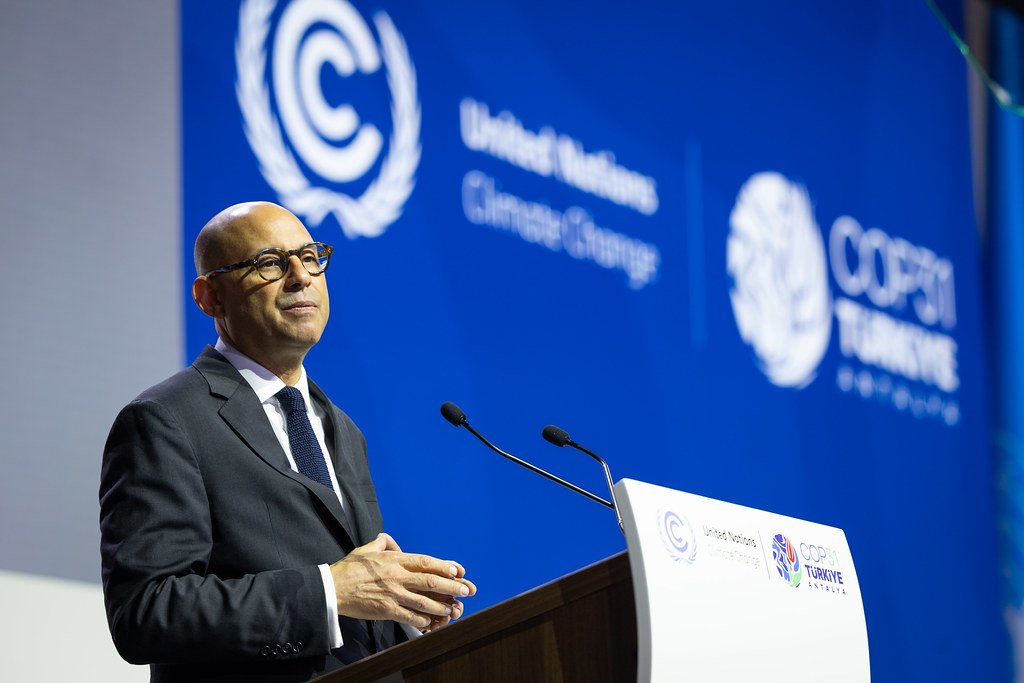
Featured image: Simon Stiell delivers opening remarks at the opening of COP31, Antalya, 9 November 2026. Photo: © UN Climate Change, Kiara Worth, CC BY-NC-SA 4.0.
Sources
UNFCCC, Annual report of the Supervisory Body for the Article 6.4 mechanism, FCCC/PA/CMA/2026/8, 22 October 2026.
IISD Earth Negotiations Bulletin, COP31 daily report, 13 November 2026.
Carbon Brief, “Analysis: Climate finance pledges fall 70% as countries meet at COP31”, 11 November 2026.
Carbon Brief Connect, COP31 midway negotiations update, 14 November 2026.
UNEP, Emissions Gap Report 2026 press release, 21 October 2026.
UNEP, Adaptation Gap Report 2026, 4 November 2026, via IISD SDG Knowledge Hub.
WMO, State of the Climate Update for COP31, 9 November 2026.
Global Carbon Budget 2026, preprint, Earth System Science Data, DOI 10.5194/essd-2026-895, 10 November 2026.
UNFCCC, NDC, BTR and NAP synthesis reports news, 27 October 2026.
Indonesia, Second Nationally Determined Contribution, October 2025.
IETA, COP31 daily reports, 10 to 13 November 2026.
UK Government and Government of Canada, UK-Canada climate finance joint statement, 13 November 2026.
COP31 Presidency, Programme Overview.
Reuters, “UN climate chief urges speed as COP31 confronts fossil-fuel divide”, 14 November 2026.
ANTARA reporting of the Indonesian delegation’s COP31 statements, 9 to 13 November 2026, via Indonesian media reposts.