
Indonesia has made one of its boldest energy bets yet. Under the B50 mandate, diesel sold in the country must contain 50% palm-based biodiesel, up from 40% under B40. The mandate took legal effect on 1 July 2026 and was formally launched by President Prabowo Subianto on 9 July, with full implementation scheduled from 1 October 2026 after a three-month transition. It is the latest step in a programme that began with a 2.5% blend in 2008 and was raised to B40 in 2025 — and the President has also pushed for an eventual move towards B100, though no formal timeline has been set.
For a country that is both the world’s largest palm oil producer and a major fossil-fuel importer, the logic is easy to state: use a domestic crop to displace imported diesel, save foreign exchange, support plantation jobs, and cut emissions at the tailpipe. The controversy is equally easy to state: a fuel that looks clean when it burns may not look clean when the full lifecycle — especially land-use change — is counted.
What B50 promises
The government’s case rests on three claims: energy security, economic savings, and emissions.
On energy security, B50 is presented as a way to eliminate diesel imports entirely. On economics, official projections cited in recent coverage put biodiesel demand at roughly 16.7–18 million kilolitres and crude palm oil use at roughly 15.2–16.3 million tonnes, with around 2.1 million workers employed in the process, and additional foreign-exchange savings of Rp36.7 trillion compared with B40. Other official statements have put total foreign-exchange savings from eliminating diesel imports higher, at around Rp170 trillion per year — a reminder that headline figures depend heavily on the baseline chosen.
On emissions, the picture is similar. One widely cited government justification is a cut of approximately 44–46 million tonnes of CO2e per year compared with conventional diesel. A more incremental framing, comparing B50 with the existing B40 mandate, puts the additional saving at up to 4.8 million tonnes. Both figures can be true at once; they measure different things. Neither, on its own, settles the climate question.
Why the climate case is contested
The central criticism, raised by researchers and advocacy organisations including the Institute for Essential Services Reform (IESR) and Greenpeace Indonesia, is that combustion savings do not capture the emissions from expanding palm oil production — particularly on peatlands, where drainage and clearance can release large amounts of stored carbon.
Three land-use risks sit behind that criticism:
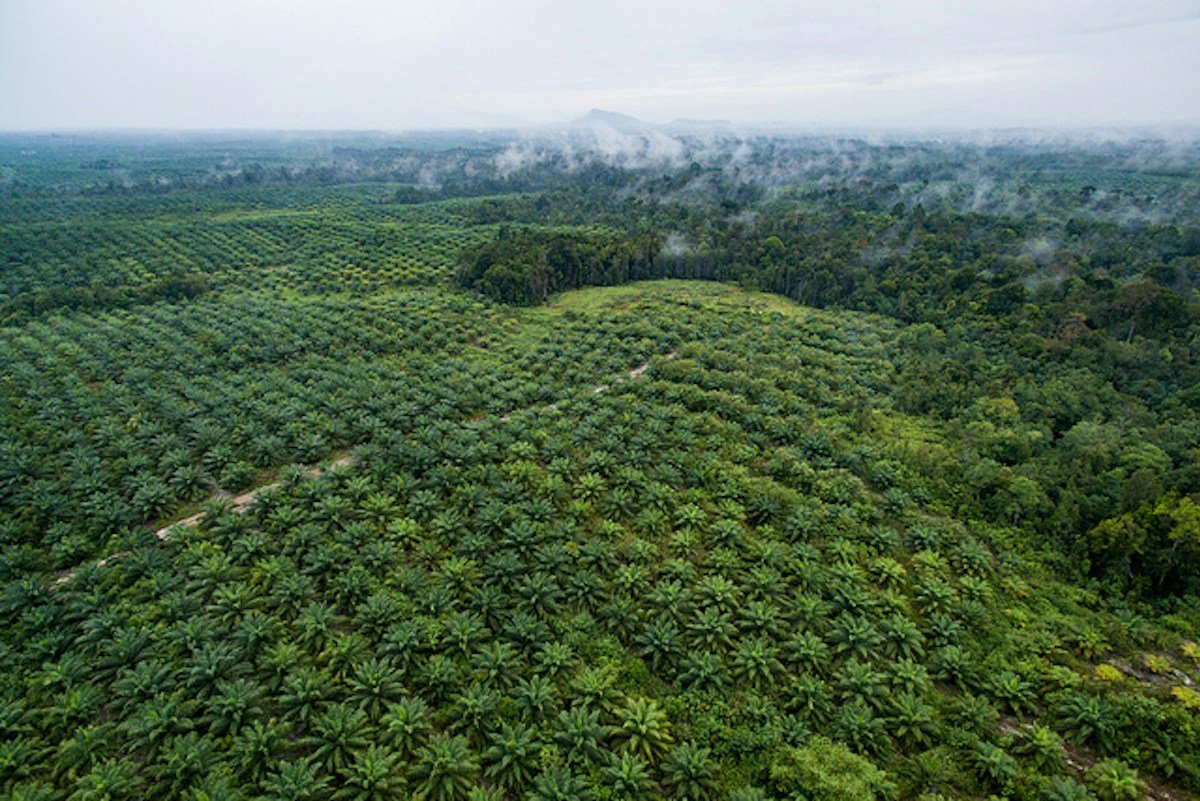
- Expansion pressure. Meeting B50 requires millions of additional tonnes of palm oil each year. A USDA Foreign Agricultural Service update summarised in recent market coverage projects domestic palm oil consumption rising by 11% to 25.3 million tonnes, with industrial use rising 16% to 17.4 million tonnes, while production is forecast slightly lower on drought conditions and exports are forecast to fall. Industry analyses likewise project biodiesel’s share of Indonesian palm oil production rising from around 27% in 2025 to around 31% in 2026 and 34% in 2027. Demand of that scale does not appear from nowhere; it must come from higher yields, replanting, or new land.
- Forest and peat. Satya Bumi has estimated that B50 could require a further 5.36 million hectares by 2039, with up to 1.5 million hectares of deforestation — an estimate, not a settled fact, but one that illustrates why the location of new supply matters more than the national average. Reports have also noted a claim that 12.7 million hectares of “degraded forest” would be used for oil palm to serve the biodiesel programme — the same area previously pledged for reforestation — which, if confirmed, would raise obvious questions about additionality and forest protection.
- Food, exports, and inputs. Shifting palm oil from export and food markets into fuel has distributional effects: tighter export supply, potential pressure on cooking-oil availability and prices, and new import dependencies of its own — notably methanol for biodiesel production, which one analysis puts at roughly Rp20 trillion per year because domestic capacity remains limited. A policy sold partly on import independence therefore needs a full balance sheet, not only a diesel-import line.
The legal and policy test
This is where B50 stops being only an energy story and becomes a climate-law story. Whether B50 helps or harms Indonesia’s climate goals will be decided less by the blend percentage than by the rules around it:
- Lifecycle accounting. Is the programme’s emissions claim calculated on a full lifecycle basis, including direct and indirect land-use change, peat emissions, and methanol inputs — and is that calculation published and independently verifiable?
- Traceability and no-expansion safeguards. Can biodiesel feedstock be traced to plantations that are legal, certified, and not recently cleared from forest or peat? Certification systems such as ISPO, deforestation-free sourcing rules, and peat moratorium enforcement are the practical instruments here; their credibility depends on audit, disclosure, and consequences for non-compliance.
- Land legality. Indonesia has reported millions of hectares of oil palm inside forest areas. A biodiesel mandate that increases demand without resolving illegal plantation status, forest-area release, and smallholder legality risks rewarding the very expansion the climate agenda is meant to prevent.
- Benefit sharing. Smallholders produce a large share of Indonesia’s palm oil. If B50’s value is captured mainly by large mills and fuel blenders, while smallholders bear price, certification, and replanting costs, the programme will struggle on both equity and supply grounds.
- Consistency with climate commitments. B50 sits alongside Indonesia’s wider climate framework — including its carbon market, its forestry and land-use net-sink goal, and the climate, renewable-energy, and electricity bills now under parliamentary discussion. A biofuel policy that counts as an emissions saving in the energy sector while generating emissions in the land sector does not reduce the national total; it moves the accounting.
What would make B50 a credible climate policy
A credible version of B50 would not require abandoning biodiesel. It would require proving, project by project and year by year, that the fuel is genuinely low-carbon:
- Publish full lifecycle emissions, including land-use change and peat, with the methodology and data open to scrutiny — and report B50’s effect on total national emissions, not only on tailpipe emissions.
- Tie feedstock eligibility to traceability and no-deforestation, no-peat criteria, with independent verification and public supplier lists.
- Resolve land legality before expanding demand, so that new demand does not create an incentive to clear or to regularise illegal plantations after the fact.
- Protect food supply and smallholder incomes explicitly, with monitoring of cooking-oil availability, fresh-fruit-bunch prices, and replanting support.
- Set a clear B100 test. Any future move to 100% biodiesel should be conditional on meeting the four tests above — not on a calendar date alone.
The real question
B50 is popular for understandable reasons: it converts a domestic agricultural strength into energy security, and it gives Indonesia a visible, nationally owned transition story. But popularity is not the same as climate integrity.
The test for B50, and for the wider energy transition it is now part of — alongside ethanol and a proposed 100 GWp solar programme — is whether Indonesia’s legal and regulatory system can ensure that a fuel marketed as renewable is, in fact, produced without destroying the forests and peatlands that store far more carbon than any single year’s diesel savings can offset.
If that test is met, B50 could be a genuine bridge fuel. If it is not, Indonesia risks paying for energy security with the very natural capital its climate commitments depend on — and discovering, too late, that compliance and impact were never the same thing.