
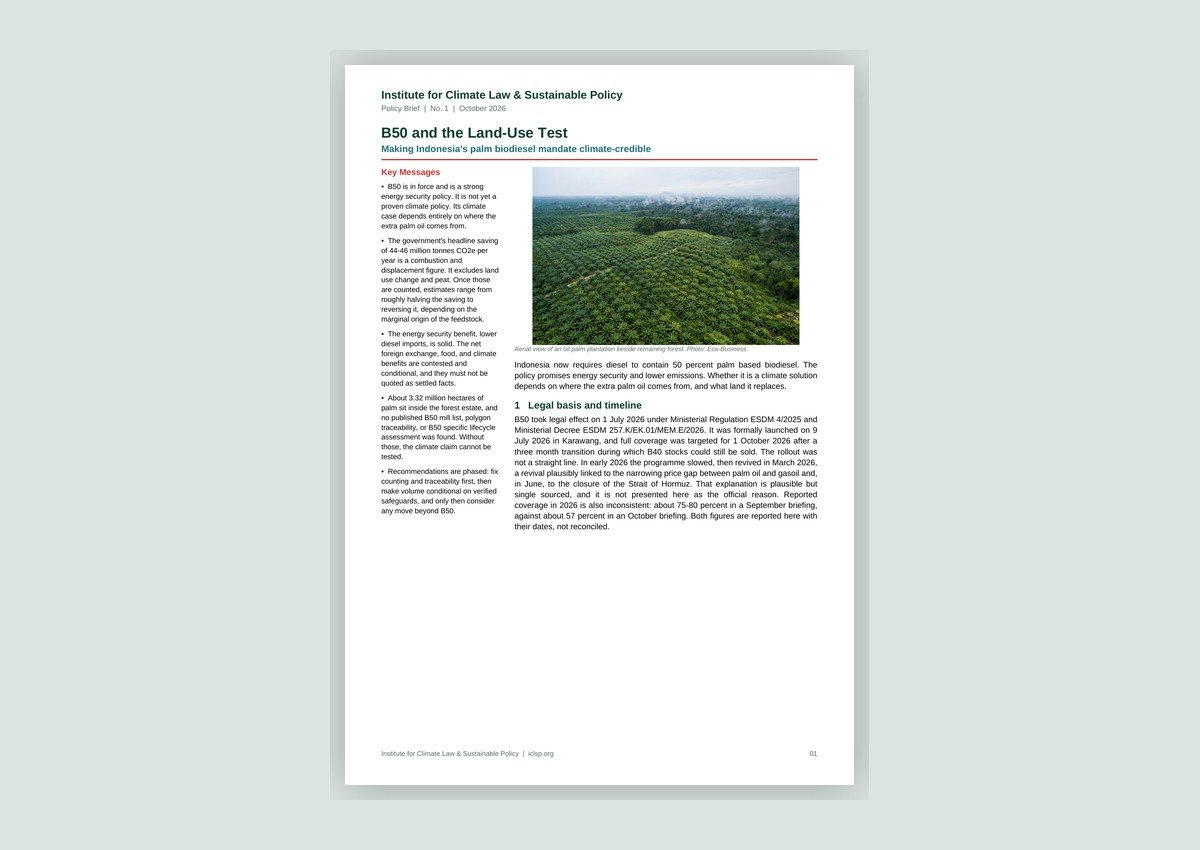
From the Institute for Climate Law & Sustainable Policy, Policy Brief No. 1, October 2026. Indonesia now requires diesel to contain 50 percent palm based biodiesel. B50 is in force and is a strong energy security policy, but it is not yet a proven climate policy, because whether it is a climate solution depends on where the extra palm oil comes from, and what land it replaces.
B50 took legal effect on 1 July 2026, was formally launched on 9 July 2026, and was targeted for full coverage on 1 October 2026. The headline saving of 44 to 46 million tonnes of CO2e per year is measured against conventional diesel, while the incremental saving against B40 is up to 4.8 million tonnes, and both are measured on a combustion only basis that excludes land use change and peat. Once land use is counted, the answer can change: published palm values sit around 32 grams of CO2e per megajoule with methane capture and 54 grams without it, against a fossil diesel comparator of 94 grams, and adding California’s indirect land use change value of 71.4 grams takes the total above fossil diesel. About 3.32 million hectares of palm sit inside the forest estate, and no published B50 mill list, polygon traceability system, or B50 specific lifecycle assessment was found.
The brief therefore recommends, in phases, publishing a full lifecycle account and traceability data first, making only verified deforestation free, peat free, legally grown feedstock eligible, protecting food supply and smallholders, and holding any move to B100 until those safeguards are demonstrably in place. The full analysis, charts, phased recommendations, triggers, evidence gaps, and references are in the PDF.